Why Your Drain Keeps Blocking (It Is Probably Not Your Fault)
There is a particular type of blocked-drain job we see all the time.
The customer has had the same drain cleared two, three or four times over the last couple of years.
Each time, someone comes out, gets the water flowing again and says: “All fixed.”
Then a few months later, the toilet starts gurgling again. The sewer backs up. Or the next decent Adelaide downpour arrives and the stormwater system overflows.
The problem is that clearing a blockage and fixing the reason a drain keeps blocking are two completely different jobs.
If your drain has blocked once after years of trouble-free service, it may genuinely be a one-off.
If the same drain keeps blocking, however, there’s usually a reason. And eventually, repeatedly paying to clear it becomes more expensive than finding out what is actually wrong.
Clearing a drain is not the same as repairing it
When Harvey Trades attends a blocked sewer, stormwater drain, downpipe or waste pipe, the first priority is straightforward: get the obstruction out and get the drain flowing again.
But not every blockage requires the same equipment.
Depending on the type of drain, its location and what we believe is causing the blockage, Harvey Trades uses a range of professional drain-clearing methods, including:
- High-pressure hydrojetting
- Specialised plunging equipment
- Mechanical augers and drain-clearing equipment
- Chemical drain cleaning where appropriate
For main sewer and stormwater blockages, high-pressure hydrojetting is often one of our most effective options. Hydrojetting uses high-pressure water and specialised drain nozzles to work through the pipe and remove material such as tree roots, silt, sludge and other accumulated debris.
For more localised blockages, such as toilets, basins, sinks, showers and certain waste lines, specialised plunging or mechanical auger equipment may be the more appropriate solution.
Chemical cleaning also has its place for certain types of build-up and drainage problems, but it isn’t something we simply pour down every blocked drain and hope for the best. The method needs to suit the pipework and the material causing the restriction.
The important part is that we don’t approach every blocked drain with the same tool. We assess what’s happening and use the clearing method that makes sense for the particular blockage.
Once the water is flowing again, though, there’s another question worth asking: why did it block there in the first place?
If it was a one-off obstruction, clearing it may be all that’s required.
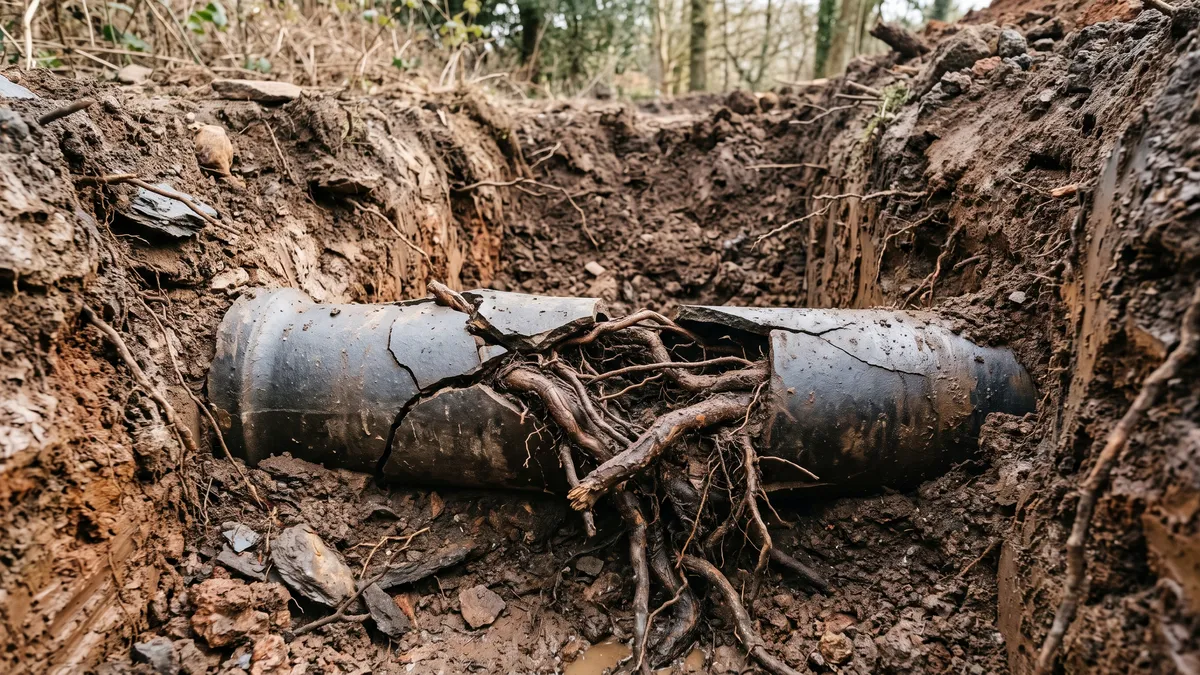
But if the drain is cracked, collapsed, misaligned, heavily corroded or repeatedly allowing roots to enter, clearing the blockage doesn’t repair the underlying pipe.
That’s the difference between clearing the blockage and fixing the drain.
Why do sewer drains keep blocking?
After clearing and inspecting blocked sewer drains around Adelaide, there are a few problems we see repeatedly.
1. Tree roots
Tree roots are one of the most common causes of recurring sewer blockages.
If there’s a deteriorated joint, crack, displacement or another opening in the drainage system, roots can find their way into the pipe.
Once inside, they continue growing and create the perfect structure for toilet paper, wipes and other waste to catch on. Eventually, the drain blocks.
Hydrojetting can cut and remove the root mass and restore flow. But if the defect allowing those roots into the pipe remains, the roots can eventually return.
That’s why recurring root blockages are a good reason to put a CCTV camera through the drain and find out where they’re getting in.
2. “Flushable” wipes
This is one we see far too often.
Just because the packet says flushable doesn’t mean the product behaves like toilet paper once it’s inside your drainage system.
Toilet paper is designed to break apart quickly in water. Wipes are considerably more durable.
They might make it through a perfectly healthy section of drainage, but give them something to catch on, such as a tree root, rough joint, misaligned pipe or foreign object, and they can quickly contribute to a serious blockage.
Our advice is simple: if it’s a wipe, put it in the bin.
3. Misaligned pipes from ground movement
Underground drainage doesn’t remain perfectly still forever.
Ground movement can cause sections of drainage to shift. Joints can become displaced and pipes can move out of alignment.
Instead of wastewater travelling through a relatively smooth internal pipe surface, it encounters a lip or restriction. Toilet paper and solids begin catching on it. More material collects. Eventually, the drain blocks.
We can clear the obstruction and restore flow, but no drain-cleaning machine can move an underground pipe back into alignment.
Once we’ve identified and located the problem, the affected section may require excavation and repair or another suitable repair method.
4. Collapsed pipework
Sometimes the drain hasn’t just moved. It has actually failed.
A cracked or collapsed section can severely restrict the internal diameter of the drain, or close it completely.
Depending on the severity, we may still be able to get clearing equipment through and temporarily restore flow. But that doesn’t mean the problem has been fixed.
If the pipe has structurally collapsed, it generally needs a permanent repair.
5. Old metal sewer and waste pipes corroding internally
This is another major problem we come across in some older Adelaide homes.
Older properties can still have sections of metal waste or sewer pipework, particularly around bathrooms and older internal plumbing.
Over many years, the inside of this pipework can corrode and deteriorate.
The important thing is that the corrosion doesn’t necessarily just make the pipe weaker. It can gradually close the pipe from the inside.
The internal opening becomes smaller and rougher as corrosion and deterioration build up. That gives toilet paper, waste and other material more places to catch. The drain becomes increasingly restricted.
Eventually, we can reach a point where the original pipe is almost completely closed over.
Sometimes we physically can’t get our equipment through
This is where what initially looks like a normal blockage can become a much bigger drainage problem.
If the pipe has corroded badly enough, there may simply not be enough internal opening remaining to get our hydrojet hose, mechanical auger or CCTV camera through the affected section.
We can attempt to restore flow where practical, but there comes a point where repeatedly trying to force equipment through severely deteriorated pipework isn’t the correct solution.
The pipe itself has failed. And unlike tree roots, wipes or accumulated debris, we can’t simply clear away the obstruction and expect the original pipe diameter to return.
The deteriorated pipework needs to be replaced.
Why this can mean digging up the bathroom
Unfortunately, this older metal drainage is often located inside the home or underneath the bathroom floor.
If the failed section is beneath a bathroom, gaining access can require disturbing floor tiles, concrete, fixtures, cabinetry or other bathroom finishes.
Nobody wants to hear that their blocked drain may require part of the bathroom to be dug up.
But if the pipe underneath has deteriorated to the point where there’s almost no usable opening left, sometimes there simply isn’t a non-invasive way to restore the drainage properly.
At that stage, accessing and replacing the failed pipework may be the only reliable solution.
Sometimes the drainage repair leads into a bathroom renovation
This doesn’t mean every corroded pipe requires a new bathroom.
If the bathroom is relatively modern and we can access the failed drainage with minimal disruption, the priority may simply be to repair the pipe and reinstate the affected area.
But if it’s an older bathroom that was already approaching renovation time, the conversation can be different.
If tiles, flooring, concrete or fixtures already need to be removed to access failed drainage underneath, some homeowners decide it makes more sense to replace the deteriorated plumbing and renovate the bathroom at the same time.
Instead of paying to pull apart an ageing bathroom, repair the drain and then rebuild the old bathroom exactly as it was, the drainage failure can become an opportunity to address both problems properly.
Harvey Trades can assess the drainage issue first and discuss the available options before you make that decision.
The blocked drain should determine what plumbing work is actually required. The condition of the bathroom then determines whether simple reinstatement or a larger renovation makes more sense.
6. Foreign objects
You would be surprised what ends up inside drains.
Some objects have been flushed or washed down. Others have found their way into the drainage system during construction or previous work around the property.
And occasionally we put the CCTV camera down and find something that makes us wonder how it got there in the first place. We’ve even encountered a gas pipe running straight through a drain.
So yes, sometimes the blockage really is caused by something completely unexpected.
That’s one of the biggest advantages of CCTV inspection. Instead of guessing, we can actually look.
Stormwater blockages are a different problem
Sewer and stormwater drainage are both underground pipe systems, but they deal with very different things.
Your sewer system carries wastewater from toilets, showers, basins, kitchens and other fixtures.
Your stormwater system has to deal with rainwater from your roof, gutters, downpipes, surface drains, stormwater pits, driveways and paved areas.
When Adelaide gets a decent downpour, a stormwater system can suddenly be asked to move an enormous amount of water. If something is wrong underground, that’s often when you find out about it.
What commonly blocks stormwater drains?
Tree roots. Roots are one of the biggest problems we find in stormwater systems. Stormwater drainage can contain relatively thin-walled pipework, and older systems can be particularly vulnerable to ground movement, damaged joints and cracking.
Once there’s an entry point, tree roots can make their way into the drain. From there, they collect leaves, dirt and other debris until the effective opening through the pipe becomes smaller and smaller. Then heavy rain arrives and the system can’t get rid of the water quickly enough.
Collapsed or damaged stormwater pipework. Ground movement, ageing pipework, poor bedding and external loads can all contribute to damaged stormwater drainage. A pipe may crack, deform, separate or collapse.
Once that happens, dirt and surrounding material can enter the drain while water flow becomes restricted. Hydrojetting can remove loose material and restore flow where possible, but if the pipe itself has failed, the permanent solution may be to repair or replace the damaged section.
Silt, dirt and debris. Stormwater drains naturally deal with considerably more dirt and debris than sewer drains. Leaves, soil, sand and sediment can enter through surface drains, gutters and pits.
Over time, that material can settle inside the drainage system. We regularly find stormwater pits and pipes containing substantial amounts of silt and dirt. Hydrojetting can be used to work through the drainage line and remove accumulated material, while pits may also need to be physically cleaned out.
Animals. Yes, this actually happens. Stormwater systems can occasionally become home, or unfortunately a dead end, for animals. Possums and snakes can find their way into stormwater systems and become trapped.
It isn’t the first thing we’d suspect when a stormwater drain stops flowing. But it’s another example of why a CCTV camera can be extremely useful when a blockage doesn’t make sense. Sometimes what we find underground isn’t what anybody expected.
Sometimes your stormwater isn’t blocked, it is undersized
This is an important distinction.
If your stormwater system struggles every time there’s heavy rain, the problem isn’t necessarily a blockage. The existing drainage may simply be unable to handle the volume of water being discharged into it.
Stormwater drainage needs to be appropriately designed and sized for the amount of water it is expected to carry. Factors can include:
- Roof catchment area
- Number and location of downpipes
- Pipe diameter
- Pipe grade
- Number of connections
- Surface drainage
- Existing stormwater layout
- Where the system ultimately discharges
You can have perfectly clean stormwater pipework and still experience overflowing gutters, surcharging pits or water backing up if the system isn’t capable of carrying the volume entering it.
This is why stormwater sizing matters. Clearing an undersized pipe isn’t going to make the pipe larger.
If capacity is the underlying problem, the drainage layout may need to be assessed and upgraded rather than simply cleaned again.
Don’t forget the downpipes
The underground stormwater drain isn’t the only place a blockage can occur. Downpipes can block too.
Leaves, dirt, roof debris and other material can build up inside a downpipe or around its connection to the underground stormwater system.
A blocked downpipe can contribute to gutters overflowing, poor roof drainage, water spilling around the building, water backing up during heavy rain and stormwater failing to discharge properly.
Harvey Trades can clear blocked downpipes as part of investigating stormwater drainage problems. If the downpipe itself is damaged, deteriorated or needs replacing, we also offer downpipe replacement.
The important part is working out whether the restriction is actually in the downpipe, the underground drainage, or whether the overall stormwater system is struggling with capacity.
How do we actually find out what’s wrong?
This is where blocked-drain work becomes diagnosis rather than guesswork.
The exact process depends on the blockage, but for recurring underground drainage problems it will generally involve some combination of:
Clear, then CCTV, then locate, then repair.
Each stage tells us something different.
Step 1: Clear the blockage
First, we need to restore flow. Depending on what we’re dealing with, Harvey Trades may use:
- High-pressure hydrojetting
- Specialised plunging equipment
- Mechanical augers
- Chemical cleaning where appropriate
- A combination of methods for more difficult blockages
The right method depends on what is blocked and what’s causing it.
A blocked toilet doesn’t necessarily need the same equipment as a sewer main full of tree roots. A kitchen waste restricted with accumulated build-up is different again. And a stormwater pipe packed with silt, roots and debris presents another completely different problem.
For sewer and stormwater mains, hydrojetting gives us the ability to work through substantial blockages using specialised equipment and nozzles selected for the job.
Once we’ve restored enough flow and access, recurring underground drainage problems can then be investigated further.
Step 2: CCTV drain inspection
Once the drain is clear enough to inspect, we can send a specialised CCTV drain camera through the pipe.
Now we’re not guessing. We’re actually looking at what’s happening underground.
We may find:
- Tree-root entry
- Misaligned joints
- Cracked pipework
- Collapsed sections
- Severely corroded pipework
- Foreign objects
- Water holding within sections of pipe
- Silt and debris
- Changes in pipe material
- Other structural defects
And every now and then, we find something nobody expected. Like a gas pipe running straight through the drain.
The CCTV inspection gives us the information we need to determine whether the blockage was simply an obstruction or whether there’s an underlying problem that needs further attention.
There are situations, particularly with severely corroded old metal drainage or a complete collapse, where we physically can’t get the camera through. That tells us something too.
If the pipe has deteriorated to the point that professional drain equipment can’t pass through it, further access or excavation may be required to determine the extent of the failure and restore the drainage.
Step 3: Locate the problem
Knowing there’s a collapsed section somewhere underground isn’t particularly helpful if nobody knows where it is.
Harvey Trades also offers electronic drain pipe locating.
Using specialised locating equipment with our CCTV drain camera, we can help determine the position of the problem from above ground where access allows.
That means if excavation is required, we can target the area where the defect has actually been identified rather than unnecessarily digging up large sections of the property looking for it.
This can be particularly valuable where drainage runs beneath lawns, gardens, paving, concrete, driveways or other finished areas.
Find the problem first. Then work out the best way to access and repair it.
Step 4: Repair it if required
Once we know what the problem is and where it is, we can determine whether the drain actually requires repair.
Not every blockage does.
Sometimes we clear the obstruction, inspect the pipe and find that the drainage itself is in reasonable condition. That’s a good result.
But where structural damage is causing recurring problems, Harvey Trades can provide dig-up and pipe repairs or drain pipe relining where suitable.
The repair recommendation comes after we’ve worked out what’s actually wrong, not before.
Dig-up and pipe repairs. Sometimes excavation is the simplest and most appropriate repair.
If we’ve located an isolated collapsed, broken, badly corroded or misaligned section, we can excavate the affected area, expose the drain and replace the failed pipework.
There’s no point replacing a large section of drainage if one isolated defect is causing the problem. Where practical, we can target the actual defect and repair what’s required.
For internal drainage, this may sometimes involve accessing pipework beneath bathrooms or other finished areas. We’ll assess the situation and explain the likely extent of the work before proceeding with a permanent repair.
Drain pipe relining. In suitable situations, pipe relining can allow damaged drainage to be repaired without excavating the entire affected section.
A liner is installed within the existing drainage pipe, effectively creating a new internal pipe through the damaged area.
This can be particularly useful where the drain runs beneath concrete, driveways, paving, landscaping or other difficult-to-access areas.
Relining isn’t suitable for every drainage problem. If a pipe is severely collapsed, badly misaligned or corroded to the point that there isn’t sufficient usable pipe remaining, excavation may still be necessary.
That’s why we don’t decide on the repair method before investigating the drain.
Clear it first. Camera it. Locate the problem. Then choose the repair that actually makes sense.
When should you investigate a recurring blockage?
You don’t necessarily need a CCTV investigation every time a sink drains slowly or a toilet blocks once.
But we’d strongly consider further investigation when:
- The same drain has blocked multiple times
- Tree roots repeatedly return
- The drain blocks again shortly after being cleared
- Wipes and waste repeatedly catch in the same location
- You have older underground drainage
- Your home contains old metal drainage
- Clearing equipment repeatedly encounters a problem at the same location
- We physically can’t get equipment through part of the drain
- There are signs of collapsed or damaged pipework
- Your stormwater repeatedly backs up during rain
- Downpipes continually overflow
- You’re considering excavation or pipe relining
At that point, another drain clear may only restart the clock.
The honest advice
If your drain has blocked once after years of trouble-free service, get it properly cleared and carry on with your life. It may genuinely have been bad luck.
But if the same sewer or stormwater drain has blocked two, three or four times, stop treating every blockage like an unrelated event. Something may be causing it.
The better approach is: clear it, camera it, locate the problem, then decide whether it actually needs repairing.
Sometimes the CCTV inspection shows a relatively healthy drain and no major repair is required. That’s a good result.
Other times, it shows roots entering through a damaged joint, a collapsed section, badly misaligned pipework, an old metal pipe that’s almost completely corroded closed, or something completely unexpected sitting in the middle of the drain.
Either way, you finally know what you’re dealing with.
Blocked drain services from Harvey Trades
- Hydrojet sewer drain clearing
- Hydrojet stormwater drain clearing
- Blocked downpipe clearing
- Specialised drain plunging
- Mechanical auger drain clearing
- Chemical drain cleaning where appropriate
- CCTV drain inspections
- Electronic drain pipe locating
- Tree-root removal
- Stormwater silt and debris clearing
- Sewer and stormwater fault diagnosis
- Drain excavation and dig-up repairs
- Broken, collapsed and misaligned pipe repairs
- Replacement of severely corroded drainage
- Bathroom drainage excavation and replacement
- Drain pipe relining
- Downpipe replacement
We have a range of professional drain-clearing, CCTV and locating equipment available, which means we aren’t limited to approaching every blockage in exactly the same way.
The aim isn’t to turn every blocked drain into a major repair. If it simply needs clearing, we’ll clear it.
But if you’re dealing with the same blockage over and over again, we can investigate what’s happening underground and determine whether there’s actually a problem that needs repairing.
And if a permanent repair is required, we can provide targeted excavation and pipe repairs or drain relining where suitable.
In some older Adelaide homes, that investigation can uncover drainage beneath the bathroom that has reached the end of its usable life. Where accessing and replacing that drainage means substantial disruption to an ageing bathroom, we can also discuss whether it makes more sense to incorporate the plumbing work into a broader bathroom renovation.
Because getting the water flowing again is important. Finding out why it stopped flowing in the first place is how you stop coming back to the same problem.